On Collaborating With My Own Kids
(spoiler alert: it was a fabulous experience)
If you’ve been following me for a while, you are already aware that I have a deep love of literature from ancient Greece and Rome. If you haven’t…well, now you know. And, of course, in my former profession (I’ll have to do a set of blog posts about that change soon), I was a teacher of literature from ancient Greece and Rome.
I also homeschool my kids. It’s a fairly recent development fueled by several factors (not religious or political ones; I’m a woke-ass atheist), but it’s been fantastic. It turns out that my kids are not only smart but pretty freaking cool (ok, ok, maybe I’m biased), and getting to teach them stuff – and learn other stuff along with them – has been an absolute pleasure.
Anyway, at the beginning of this school year, my kids and I read a book together called The True Confessions of Charlotte Doyle by Avi. I remembered loving it in my youth, and it did not disappoint thirty years later. One of the central dilemmas that the protagonist of the book faces is whether or not to stand up to an authority figure who’s in the wrong. She chooses to do so even though it endangers her, setting off a chain of deadly events.
This put me in mind of the ancient Greek tragedy Antigone, which involves a young woman standing up to a king and fighting for what she believes is right, setting off a chain of – you guessed it – deadly events. It’s one of the most (possibly the most) frequently-performed Greek tragedies even today, because its themes are (sadly) still quite relevant.

I thought my kids would enjoy the story of Antigone, and, as a Classics enthusiast and teacher, I also wanted to seize the opportunity to introduce them to Greek tragedy in general. But most translations of the play are dense, complex, and difficult to understand (mostly because the Greek is, too). My kids, being a bit too young to understand and appreciate Shakespeare, were also too young to understand English translations of the Greek version of Shakespeare.
So. I made my own translation, one intended for young(ish) readers. I didn’t change anything about the plot of the play. Characters still speak roughly the same number of lines in the same order. I don’t hold back on any of the fear and grief and death that arise in the play. But the language is simpler, long monologues and choral odes are shorter and more straightforward, and I included an easy-to-read introduction to Greek theatre and some discussion questions for us to consider after we’d read the play.
Now here’s where things get cool: my kids were my beta readers. They read my introduction and gave me feedback about things they thought were either unnecessary or needed more explanation. The three of us read through the play, taking on the different characters, and they helped me find typos and places where the translation was awkward or unclear.
It turned out that this was not only useful for me (as I had by now decided I was going to publish the thing); it was an excellent pedagogical exercise for them, too. They were excited to have input that would help me publish another book, which meant they were far more engaged than usual. My daughter, a theater enthusiast, reveled in the role of Antigone. My son, usually reluctant to read aloud, found the conversational lines more palatable (and he loved the role of the Guard, which is one of my favorites, as well). They engaged with the text and the discussion questions with deeper insights than I’ve ever heard from them.
We had plenty of laughs along the way, too. For example, about two-thirds of the way through the play, as the guards were leading Antigone toward her death, my kids insisted, “She can’t die. She’s the title character!” By the time we got to the end of the play and they realized they’d made a bad assumption, I just smiled and said “Welcome to Greek tragedy.”
It was an incredible experience, and even if no one reads my version of Antigone, I call it a win. However, I do hope that others – whether they are young readers or simply people who want a straightforward introduction to Greek tragedy – will enjoy the fruits of our labors. I’ll provide a link below…just in case.
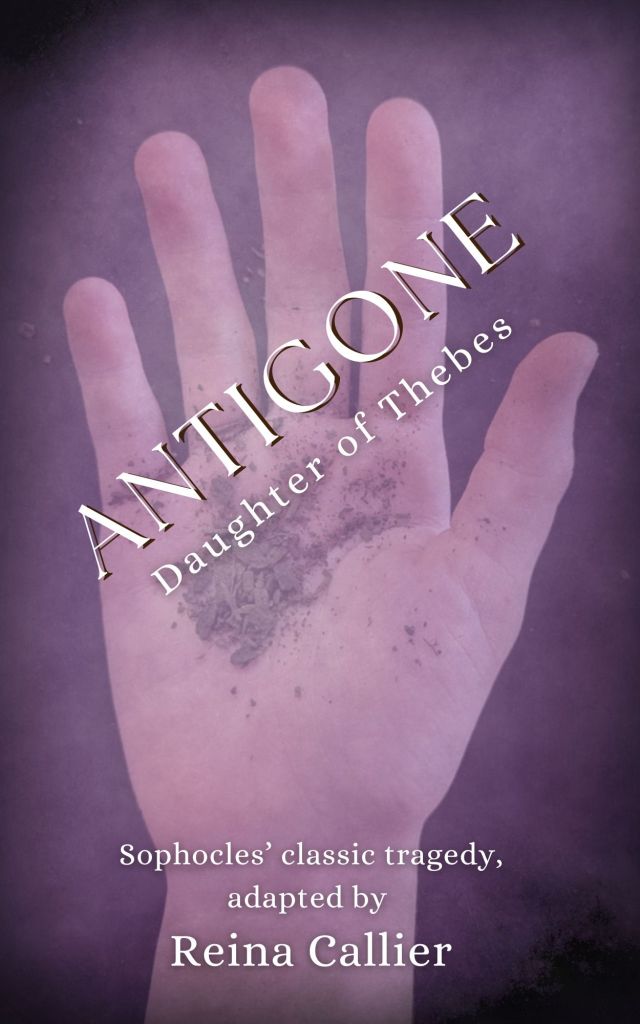
And yes, that is my daughter’s hand on the cover.
In Proximum, Regina Vestra


Leave a Reply