Greek Tragedy Countdown, #4: Good For Her
The “her” is Hecuba, the queen of Troy, because today I’m going to talk about TWO tragedies that feature Hecuba as a central character (I know, it’s cheating, but I really couldn’t decide between them!). The plays are The Trojan Women and Hecuba, both by Euripides.
Just as a quick reminder, I’m doing this countdown as a way to promote the upcoming release of my middle-school-friendly adaptation of Sophocles’ Antigone. OK, that’s enough promotion! Let’s jump in.
I first read Euripides’ Trojan Women when I was eight years old. I was visiting my grandmother in New York for the summer, as I often did, and she left Gilbert Murray’s translation of Trojan Women on my pillow, thinking I would like it.
I adored it. It opened my little eight-year-old mind in a way nothing ever had before. The exploration of the pain of the victims of war was so stunning, so heartbreakingly beautiful, that it had me literally sobbing. Reading that play made me who I am today, and I’ve had the pleasure of sharing that play with my students on several occasions.
But it really is depressing as hell (I know, shocking for a tragedy). It’s set after the Greeks destroy the city of Troy, and it follows the experiences of the Trojan women as they get sacrificed or doled out as slave-women for the Greek captains, and as they watch their children get hurled to their deaths from the walls of their once-great city.
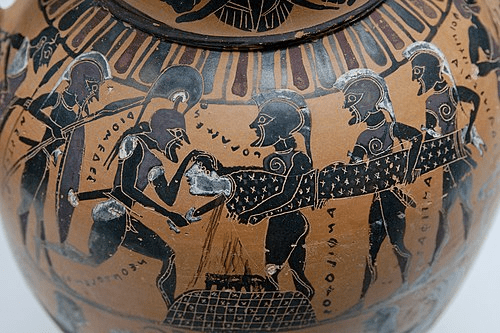
[The Trojan princess Polyxena literally getting sacrificed on Achilles’ grave.]
One bright spot in an otherwise bleak play is an argument that occurs between Hecuba, the elderly queen of Troy, and Helen (you know, the woman for whose sake the whole war was fought). Helen’s Greek husband Menelaus has his mind set on killing Helen now that he’s got his hands on her again, but Helen comes out on stage and convinces him to let her defend herself. The Trojan queen Hecuba listens, seething with anger, and once Helen has finished, she issues a scathing takedown of Helen’s defense, dismantling each argument point by point and convincing Menelaus not to let Helen off the hook.*
*For now, at least; we know that they will eventually end up back in in Sparta, happily married, when the events of the Odyssey take place.
Hecuba’s role in the play Hecuba (as one might guess from the title) is even more significant. And unlike the unrelentingly bleak Trojan Women (which focuses solely on the women’s suffering), Hecuba gives the queen of Troy a satisfying revenge plot. Hence the “Good for Her” in my title. When the play begins, Hecuba is still in a terrible position. She’s languishing in the Greek camp outside of Troy, and she has seen most of her children die or become slaves like herself, but she has one hope yet remaining: the belief that her youngest son Polydorus, whom she had entrusted to the Thracian king Polymestor for safekeeping, is still alive. Unfortunately, it turns out that this hope is baseless, for just then, Polydorus’ dead body washes up on shore.
Here’s where things get interesting: Hecuba does something about it. In this play, the Greeks are quite respectful of the former queen, especially king Agamemnon, whose relationship with Hecuba’s daughter Cassandra sways him favorably in Hecuba’s direction. Hecuba convinces Agamemnon to let her invite the Thracian king Polymestor to dinner, and she promptly KILLS Polymestor’s children and stabs Polymestor’s eyes out. Polymestor, who at this point is outraged, grieving, and probably in a lot of physical pain, complains to Agamemnon, but after Hecuba gives a detailed defense of herself (showing her rhetorical abilities the same way she does in The Trojan Women), Agamemnon sides with her.
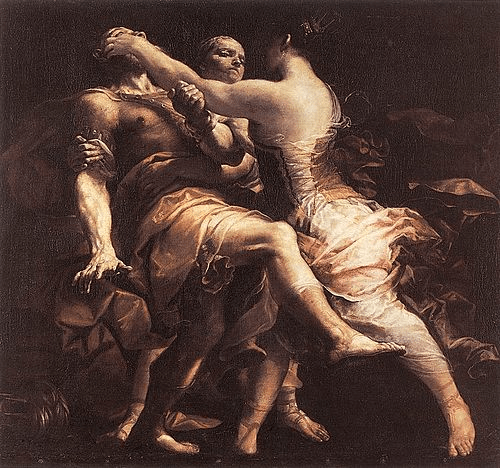
[Hecuba doing her thing to Polymestor. She looks pretty good for a woman with, like, twenty kids.]
So, here’s what I love about these plays:
- The exploration of the aftermath of war, especially when it comes to the suffering of women and children, and the way Hecuba in particular, as the mother of so many of the Trojans who died, represents the deep losses war inflicts.
- The brilliant moment of power Hecuba is given in the play Hecuba, an intensely satisfying moment of vengeance and agency in the midst of her most helpless and hopeless circumstance.
- The historical context: The Trojan Women, the bleaker of the two plays, was performed shortly after the Athens absolutely obliterated the island of Melos and its citizens during the Peloponnesian War. Indeed, Euripides may have written this sadder version of things in order to express his condemnation of Athens’ cruelty.
That’s all for now! I’ll be back with another installment soon. Subscribe if you’d like to be kept up to date.
In Proximum, Regina Vestra


 Reina Callier (Artes Reginae Press)
Leave a reply to ICYMI: My Top Ten Greek Tragedies, The Ultimate Post – Reina Callier (Artes Reginae Press) Cancel reply