Greek Tragedy Countdown, #10: A Devoted Son Makes An Impossible Choice
Not me realizing it’s been a MONTH since my last post. Yeesh, I need to get better at this.
Anyway, I have some exciting news: my middle-school-friendly adaptation of Antigone, one of the best-loved ancient Greek tragedies, is set for release on March 1st!
In honor of this release, I’m doing a daily countdown of my top ten favorite Greek tragedies (I’ll do two posts today, since I’m a bit behind)!
10. Libation Bearers by Aeschylus
Aeschylus is the oldest of the “big three” tragedians (Aeschylus, Sophocles, and Euripides). He is also the author of the only extant tragic trilogy we have, the Oresteia, which was performed in 458 BCE. The three plays in that trilogy are Agamemnon, Libation Bearers, and Eumenides. Of these three, Libation Bearers is usually given the least attention, but it’s my favorite.
For some background, in the first play of the trilogy, Agamemnon, the Greek king Agamemnon comes home from the Trojan War after more than a decade. In his absence, his wife Clytemnestra has been busy: not only has she taken a lover named Aegisthus, but she’s been plotting her husband Agamemnon’s demise (because he literally sacrificed their daughter Iphigenia when he left for Troy). Agamemnon doesn’t suspect a thing, and he is killed by Clytemnestra shortly after his triumphant return.
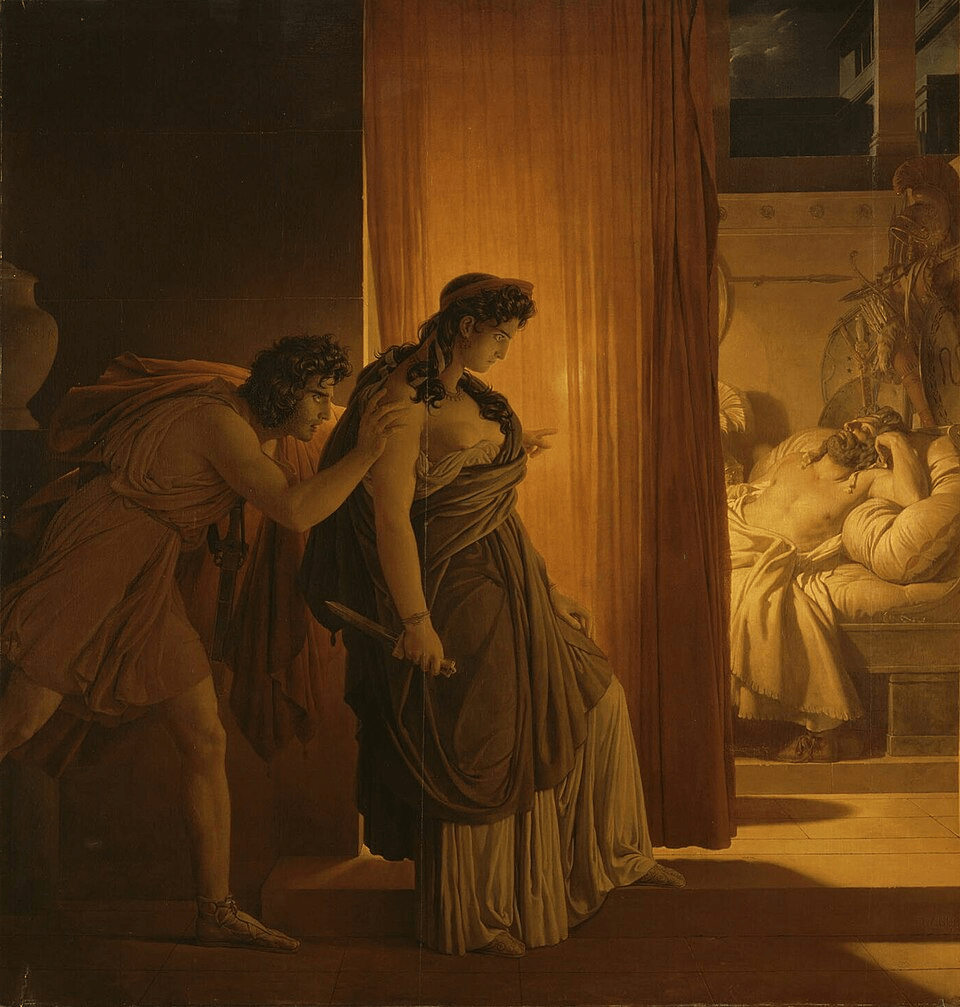
[Oh yeah, she’s mad. This is “Murder of Agamemnon” by Guerin, 1817]
The second play, Libation Bearers (my 10th favorite Greek tragedy), picks up several years later. Agamemnon’s son Orestes, who has been gone for many years, returns to his homeland with the express purpose of killing his mother to avenge his father. He doesn’t want to do it, but the god Apollo has told him that he must. And, as we all know, it’s not good to refuse the gods’ orders. In the first part of the play, Orestes reunites with his sister Electra, who – like everyone in the city – has been suffering for many years under the tyranny of her mother and Aegisthus. After getting the lay of the land from Electra, Orestes proceeds to kill both Aegisthus and his own mother, Clytemnestra.
So why do I love this play so much?
First, the recognition scene between Orestes and Electra. Electra sees footprints in the ground that are the same as her own. She sees a lock of hair on the ground that is the same as her own. And these are two of the things that lead her to believe the young man before her is truly Orestes, her brother. Obviously, this is ridiculous, and as we’ll see in tragedy #9, we’re not the only ones who think so…
But the second reason I love this play is because it is heart-wrenchingly bleak. The idea of killing one’s mother is bad enough as it is (no matter how horrible she is, and Aeschylus goes out of his way to make Clytemnestra look really bad). To make matters worse, Orestes is guaranteed to receive divine punishment from the Furies when he does it. Yes, that’s right: he’s been ordered by one god to murder his mother, but there are other gods who will punish him for it. It’s a real between-a-rock-and-a-hard-place moment. When the horrifying Furies appear at the end and start chasing Orestes, we can’t help but feel sympathy for this young man who has been put in an impossible position, and it’s a harrowing reminder that we are all constrained by external forces that we cannot begin to understand.
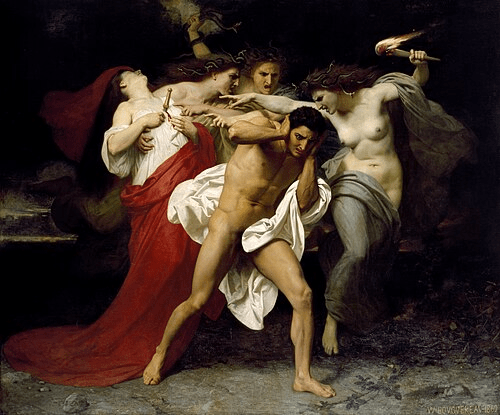
[“Orestes Pursued by the Furies,” Bouguereau, 1862. There’s a great image out there of Orestes being pursued by furries instead, which always cracks me up because that’s a common misspelling I see from my students.]
Don’t worry, in the third play of the trilogy, Eumenides, Orestes goes to trial, is acquitted (thanks to Apollo’s excellent – if sometimes disingenuous – lawyering), and is freed from the Furies’ punishment.
In the next blog post, I’ll talk about my ninth favorite Greek tragedy, which adapts – and explicitly criticizes – Aeschylus’ Libation Bearers!
In Proximum, Regina Vestra
Feel free to comment below, and don’t forget to subscribe if you want to be updated when I post!


 Reina Callier (Artes Reginae Press)
Leave a reply to Greek Tragedy Countdown, #9: Euripides Lampoons Aeschylus’ Version of Orestes’ Story – Reina Callier (Artes Reginae Press) Cancel reply