Greek Tragedy Countdown, #1: Girls Gone Wild
So maybe it was a little surprising that Antigone – the play that I am currently promoting – was not #1 on my list. That would make sense, right? You’re promoting your latest publication, so you do a top ten countdown ending with that publication as #1?
Well, that’s not what happened, because I just ADORE Euripides’ Bacchae.
This play, together with Iphigenia at Aulis (also by Euripides) is one of our latest extant plays. These plays were also Euripides’ last; in fact, he died before they were performed. When he won first place at the Great Dionysia in 405 BCE, he did so posthumously.
A quick breakdown of the play: after many years away, Dionysus, the god of wine, theatre, and reckless abandon, returns to his birthplace…good ol’ Thebes. He’s come to wreak some havoc, because his aunt Agave has been talking shit about his mother Semele, and Agave’s son, King Pentheus, is denying Dionysus’ godhood. He’s bringing his throng of worshipers, the Bacchae (so named because “Bacchus” is another of Dionysus’ names), with him. These women, who have left their homes from all over the world to follow Dionysus, rejoice in his gifts – wine and ecstasy and freedom – and they seduce the women of Thebes into joining them in their wild celebrations.
Pentheus, the king of Thebes, is not happy about this. As Dionysus’ cousin, Pentheus believes Dionysus is a human, not a mortal man, and he believes these ecstatic orgies (our word orgy comes from the Greek word for religious rite, btw) are unjustified and disruptive to the city, given that all of the women of Thebes, including his mother, have abandoned their duties to run around in the forest and dance like no one’s watching.
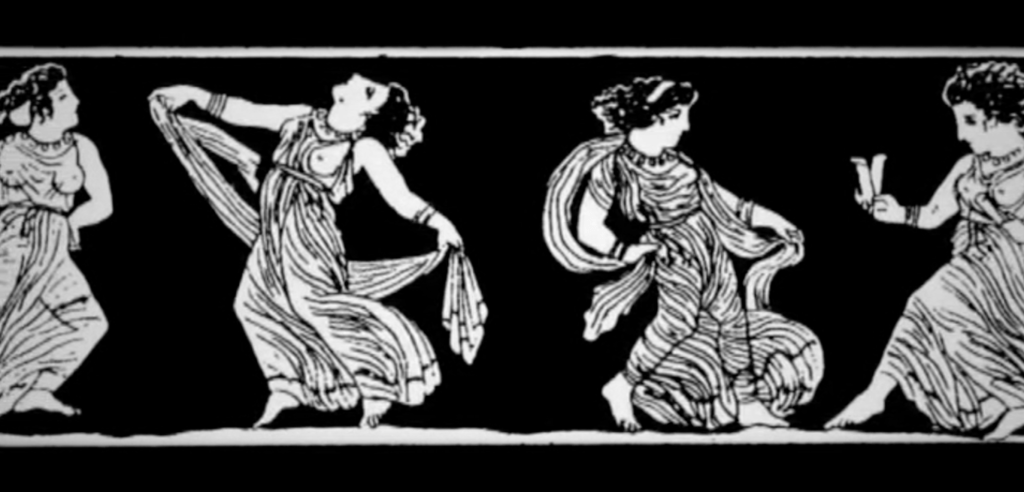
But it’s never a good idea to refuse to worship a god (as we saw in #3, Hippolytus). And the slow, sleeping, dread of this play, the inevitability of Pentheus’ demise, begins from the very start. Pentheus has imprisoned as many of the Bacchic women as he could find. Strike one. The wisest men in Thebes, the prophet Tiresias (whom we might recognize from Oedipus the King and Antigone) and Cadmus, urge Pentheus not to resist the god. Even they, old as they are, are giving in to the god’s power; indeed, they’re on their way to party when they encounter Pentheus. Pentheus shames them and criticizes their foolishness. Strike two. Dionysus himself, disguised as a mortal man, performs miracles and urges Pentheus not to underestimate the new god. Pentheus imprisons him. Strike three.
Dionysus miraculously escapes from the prison. As Pentheus reels from this strange occurrence, a messenger appears and describes the women’s Bacchic rituals as he has witnessed them. The women danced and performed miracles, he says. They stayed peaceful until they were attacked by the men who were spying on them, at which point they ran through the countryside ripping cows to shreds. It’s a wonderful bit of foreshadowing. Pentheus decides this is the last straw and calls on his army to attack the Bacchae.
Strike. Fucking. Four.
Seductive and sinister, Dionysus (who, if you remember, is pretending not to be Dionysus) calms Pentheus down and coaxes him to spy on the women instead. “Don’t you want to see?” he asks. Pentheus protests that he can’t, because he’s a man. They’ll attack him. “Why don’t you dress up as a woman?” Dionysus asks.
As the youths say, Pentheus is cooked. He gives in to Dionysus. He dresses as a woman; not just any woman, but a Bacchant. Dionysus coaches him on how to act, how to move. Pentheus exits toward the woods, ready to go and see what those women are doing.
Shortly thereafter, a messenger comes on stage and describes – in gruesome, nausea-inducing detail – the death of Pentheus, who has been ripped limb from limb by the Bacchae, including his own mother.
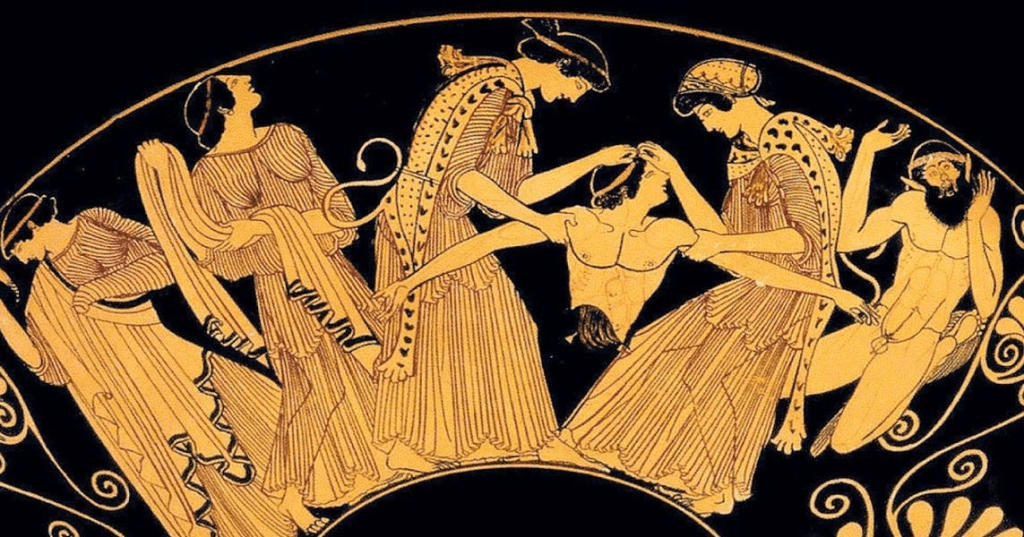
Now Agave comes on stage, holding her son’s head. Still under the influence of Dionysus’ power, she doesn’t realize what she’s holding at first…until she does. And that moment of realization is horrifying.
Apologies for the long summary, but like I said, I really love this play. And for the most part, the plot speaks for itself, but here are the things that especially appeal to me:
- The metatheatricality of it all. It’s a play about the gods of plays, being performed in a festival in honor of that god of plays. Dionysus “plays the part” of a mortal man to get what he wants from Pentheus. Pentheus goes as a spectator to watch the Bacchae, but only after he himself has been costumed and coached by his director Dionysus. And the reckless abandon that Dionysus promises – the ability to lose yourself, to step away from your usual role and the boundaries of your identity – is both seductive and threatening, its danger exemplified in the way Pentheus loses himself so intensely that he is literally torn apart.
- THE BODY HORROR. Listen, this play is like The Wicker Man and Midsommar combined with Bone Tomahawk, and someone really needs to make a fucking movie out of it. The way the seeping dread ramps up again and again until the horrible, gore-filled climax of Pentheus’ death is ::chef’s kiss::. Maybe that’s why it’s not everyone’s thing, but I’m a huge fan of horror, and this is a prime example. Reading it in the original Greek literally made my skin crawl and gave me nightmares (and it’s tough to do that these days).
Oh, and I am definitely going to be doing a novelization of it soon.
In Proximum, Regina Vestra

 Reina Callier (Artes Reginae Press)
Leave a comment