Greek Tragedy Countdown, #3: Second Thoughts Are NEVER Better
In honor of my adaptation of the Greek tragedy Antigone, which releases tomorrow,* here’s my third favorite Greek tragedy of all time: Euripides’ Hippolytus.
*Hopefully. If Amazon doesn’t mess things up.
Hippolytus involves the family of Theseus, the famed hero/king of Athens. Theseus is away, but his wife Phaedra and their children are home in the palace, as is Hippolytus, Theseus’ son by his former (and now-dead) wife, the Amazon queen Hippolyta.
Now Hippolytus, the play suggests to us, is weird, because he doesn’t like sex. In fact, he refuses to worship Aphrodite, the goddess of sex, in any way, preferring to spend his time hunting and roaming the woods with Artemis, the virgin goddess of wild things.
As it turns out, Aphrodite is NOT happy about this. This is how her revenge unfolds:
- She makes Phaedra, Hippolytus’ stepmother, fall in love with her stepson.
- Phaedra is heartsick and depressed, but she has absolutely NO intention of giving in to her feelings. In fact, she’d rather die. But then…
- Phaedra’s nurse – against Phaedra’s express wishes – propositions Hippolytus on Phaedra’s behalf. Hippolytus is disgusted and outraged, and he swears to tell his father Theseus upon his return, even though he had sworn to the nurse that he wouldn’t tell anyone.
- A panicked Phaedra realizes two things: 1) Theseus will likely kill her if he hears Hippolytus’ version of things. 2) Her reputation is paramount to her children’s safety (because ancient Greece was misogynistic AF). To avoid both of these outcomes, she kills herself and leaves a note falsely accusing Hippolytus of rape.
- Theseus comes home, sees what has happened, and immediately believes Phaedra’s note. Calling in a favor with his own father Poseidon, Theseus banishes his son Hippolytus and curses him with death.
- Hippolytus is trampled by his own horses as he flees. His friends bring his slowly-dying body back to the palace, and Theseus and Hippolytus, together with the goddess Artemis (who decides to come down to rub salt in Theseus’ wounds), discuss what really happened and lament Theseus’ impulsive anger. Then Hippolytus dies.
Y’all, it is soooooo dramatic.
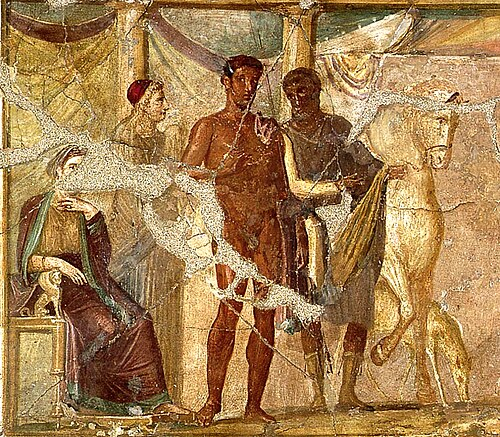
[A fresco from Pompey depicting Hippolytus and Phaedra. I’m assuming the older woman in the background is the nurse. I have no clue who the guy on the right is.]
Here are some of the things I love about this play:
- The nurse character. Believe it or not, the nurse has Phaedra’s best interests at heart (or so she thinks). Phaedra is wasting away with unrequited desire, growing listless and starving herself. The nurse is horrified at first when she finds out Phaedra is lusting after her own stepson, but after she thinks about it for a while, she decides that the only way out is through. She doesn’t want Phaedra to die; she sees adultery as the lesser of two evils. She’s absolutely wrong, of course, and her meddling leads directly to both Phaedra’s and Hippolytus’ death. But this type of character – someone whose love for the protagonist leads them to do something that leads the protagonist’s death – becomes a trope of its own (I’m thinking of Anna in Vergil’s Aeneid, for example).
- The gods SUCK. Aphrodite causes the destruction of Theseus’ family because she isn’t getting enough worship from Hippolytus. Oof. Artemis comes down on stage to criticize Theseus’ actions, but apparently isn’t willing to step in and save Hippolytus, who has loved and worshipped her all his life. Double oof.
- The sex and gender stuff. Hippolytus wants nothing to do with sex. Is he our first literary example of someone who’s asexual? Not only that, but he follows Artemis, a goddess typically associated with women. For these reasons, he’s looked down upon by nearly everyone else in Athens, and Theseus is quick to believe Phaedra’s accusation against him, as he is essentially seen as a “pervert” for his atypical behavior.
- This play has some great quotes. My favorite is the nurse’s statement that “second thoughts are often better.” This comes after she’s changed her mind and decided to “help” Phaedra get with Hippolytus. And spoiler alert: the second thoughts are absolutely not better. But there’s another quote that might be Euripides’ most famous line; indeed, it seems to have become a meme even in the ancient world! Before she tells Hippolytus about Phaedra, the nurse makes him swear an oath not to tell anyone else about their conversation. He does. After he hears what the nurse has to say, though, he immediately starts threatening to tell his father. When the nurse reminds him of his oath, he says “my tongue swore; my mind did not.” This same line appears several times in later works, most famously in a couple of Aristophanes’ comedies where he is explicitly referencing Euripides!
- I saw this play performed at the ancient theater at Epidaurus in the summer of 2023. Seeing it live was absolutely breathtaking. I will never forget it.
Alright, that’s it for Hippolytus. Come back soon (tomorrow, hopefully) for #2!
In Proximum, Regina Vestra

 Reina Callier (Artes Reginae Press)
Leave a comment