Greek Tragedy Countdown, #5: Hell Hath No Fury…
In honor of my adaptation of the Greek tragedy Antigone, which releases soon,* here’s my fifth favorite Greek tragedy of all time: Euripides’ Medea.
*I really hope no one is keeping track of how off schedule I am with these posts. It turns out that behaving like I don’t have a full-time job any more – when I absolutely still do – was not a great idea…
Euripides’ Medea is a notorious play, and that’s saying something. There’s a lot of horrific and weird shit in Greek tragedy: rape, incest, suicide, murder…but Medea ranks right up there with the worst of them, because it involves a woman “rationally” (if there is such a thing) making the choice to kill her own children.
Here’s the background: Jason and a group of heroes sailed on a ship called the Argo to retrieve the Golden Fleece, which was being held in a far-off land (Colchis) by the fierce king Aietes. Jason and his group were called the Argonauts (sailors on the Argo); their long and perilous quest is one of the most famous epic quest stories. The gods Hera and Athena were big fans of Jason, so when he finally arrived in Colchis, they conspired to help him achieve his goal by making Medea, Aietes’ daughter, fall in love with Jason. Now, “foreign princess betrays her family to help a Greek hero because she’s in love with him” is a fairly common trope, but Medea’s story is somewhat different, because she’s literally NOT LIKE OTHER GIRLS. Medea is a real badass, and Jason knows it. Swearing that he will marry her if she helps him, Jason gets Medea to whip up potions and chant spells that help him complete otherwise-impossible tasks. With her help, he gets the fleece and returns home safely. With her help, King Pelias (the asshole who sent Jason on the quest to begin with) is killed in a truly horrifying way. Soon, they are living as husband and wife and have two children.
Year later, Jason and Medea end up in Corinth, where King Creon (a different Creon from the one we see in Oedipus’ story, by the way) offers Jason his daughter’s hand in marriage.
And Jason accepts.
This is where Euripides’ play Medea begins. A scorned Medea laments her current position: not only has Jason betrayed her to marry this other woman, but King Creon, knowing how dangerous Medea is and how angry she is about the new marriage, has decided (perhaps rightfully) that it would be best to banish her.
Throughout the play, we watch Medea waver between her intense emotions and her need to find a way to help herself. Though seething with grief and anger, she uses her womanly wiles to appeal to king Creon, to Jason, and finally to Aegeus, king of Athens, who happens to be passing through Corinth. Finally, Aegeus feels sympathy for her and promises that he will give her sanctuary in Athens.
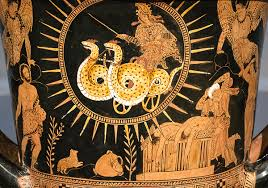
Which then gives her free reign to do what she wants…her worst. Initially, she had been planning to kill Creon, his daughter, and Jason. But after her conversation with Aegeus (who desperately wants a son of his own), Medea realizes that the best way to hurt Jason is to leave him alive but kill his kids, thereby eliminating his bloodline. She sends a poisoned dress to the princess of Corinth, which kills both the princess and the king. Then she kills her own children. It’s not easy for her; she does love them, and she almost changes her mind. But she does it. When Jason runs on stage to confront her, she flies off victoriously in a chariot pulled by dragons, a gift from her grandfather, the sun god. You can almost hear the Disney-villain-like cackle as she leaves Jason bereft and undoubtedly regretting all of his decisions.
Here are some things I love about this play:
- The way Euripides calls out the double-standards of his time. Early on in the play (before she does the very bad thing), Medea delivers a stunning monologue about how hard it is to be a woman, and how much men underestimate everything women suffer. And goddamn if she isn’t right on the money. Not only that, but she points out that killing an enemy’s children is something that men do in wartime all the time.
- The first argument between Jason and Medea is a masterpiece of rhetoric, and one that was highly influential to later works like Vergil’s Aeneid. Medea’s righteous anger is pitted against Jason’s gaslighting, “rationalizing” response. Both make excellent points, but Jason comes off as an unfeeling asshole, and the chorus – which is often meant to represent the audience’s opinions and interests – sides with Medea.
- This is directly related to the third thing I love about this play: Euripides does such a great job of pulling the rug out from under us, because we absolutely sympathize with Medea…UNTIL WE DON’T. We are on board with her anger and vengeance until the moment (fairly late in the play) when she reveals her plan to kill her own children. But at that point, it’s too late. The action has progressed too far, and we watch her go down that path with our hearts sinking in disappointment, fear, and helplessness. By the way, remember how, in my discussion of Oedipus, I said that the audience already knew the story and thus wouldn’t have been surprised by the outcome? Well, that may not have been the case for this play. There were many other versions of what happened between Jason and Medea, and though Medea’s children ended up dead in most of them, earlier accounts did not give Medea agency in their deaths (the death was either accidental or occurred at the hands of the angry Corinthians).
- This play has a reverse deus ex machina. So the deus ex machina was a common ancient Greek theatrical practice where a god would be lowered onto the stage via a “machine” (a crane), usually to help solve an unsolvable problem in the play (we use the term more generally now to describe a miraculous or unexpected occurrence at the end of a literary work that magically solves the problems of the plot). Well, at the end of the play, Medea rides in her dragon chariot from the stage up into the air (at least, that’s what many editors infer from the dialogue; there are no stage directions in the manuscripts in our Greeks play). What does this mean? Is Medea a victorious divine being escaping the consequences of the mortal world? If so…are we supposed to cheer for her or be terrified of her?

Anyway, come back tomorrow (or whenever I get to it) for number 4 on my list! And feel free to subscribe if you want to be updated whenever I publish a new blog post!
And I guess I should mention that, if you’re interested in reading my translation of the Argonautica (the epic from the 3rd century BCE that talks about Jason’s quest to get the fleece and his early interactions with Medea), you should check out my book “The Essential Argonautica” (available on Amazon)!
In Proximum, Regina Vestra

 Reina Callier (Artes Reginae Press)
Leave a comment