Greek Tragedy Countdown, #7: Orestes Conspires with Another Sister
In honor of my adaptation of the Greek tragedy Antigone, which releases in 7 days, here’s my seventh favorite Greek tragedy: Euripides’ Iphigenia Among the Taurians.
Orestes and his family sure loom large in the world of Greek tragedy. As far as extant plays go, we have three plays by Aeschylus (the Oresteia trilogy), one by Sophocles’ (Electra), and FOUR plays by Euripides (Electra, Iphigenia at Aulis, Iphigenia Among the Taurians, and Orestes) that explore this dysfunctional family. I almost said “this most dysfunctional family,” but Oedipus sets a high bar.
If you read #10 and #9 on my list, or if you have any experience with Greek tragedy, you know what I mean, but if you didn’t/don’t, here’s the dysfunction in a nutshell: When Agamemnon left for the Trojan War, he sacrificed his daughter Iphigenia at the behest of the goddess Artemis. His wife Clytemnestra was (understandably) pissed, and when Agamemnon returned more than a decade later, she and her new boy toy Aegisthus immediately killed him. Agamemnon and Clytemnestra’s son Orestes, who had been sent away from home as a boy, was ordered by the god Apollo to kill his mother in order to avenge his father. He returned home, reunited with his sister Electra, and – with her help – killed Clytemnestra and Aegisthus. Of course, killing one’s mother is generally frowned upon, and Orestes was immediately hounded by the Furies, goddesses of guilt and vengeance, forcing him to search for a way to rid himself of the blood guilt (which plays out differently in the different tragedians).

But wait, there’s more.
In some versions of things, notably Euripides’ Iphigenia Among the Taurians – #7 on my list – Iphigenia didn’t actually die. At the last minute, as Agamemnon was sacrificing her, the goddess Artemis swept her away, brought her to a temple in a foreign land, and forced her to serve as a priestess there. Euripides’ play, set many years later, begins with Iphigenia lamenting her situation. Unaware of what has happened to her family and feeling like a stranger in a strange land, she desperately wants to escape her position at the temple under King Thoas, who forces her to sacrifice any Greeks who arrive in his land.
And Apollo has just ordered Orestes to steal the statue of Artemis from that same temple.
So…enter Orestes and his friend Pylades.
Now, one of the things that I love about this play is the relationship between Orestes and Pylades. In almost all of the versions of Orestes’ story, his bestie Pylades plays a role to some degree, even if he’s merely a silent confidant. Indeed, in many classical sources, these two men are listed (alongside Achilles and Patroclus) as exemplars of male friendship and affection (and possibly more).
A while back a selection from Anne Carson’s Oresteia was circulating online, and I’ll always share it, because…awwwwwww.
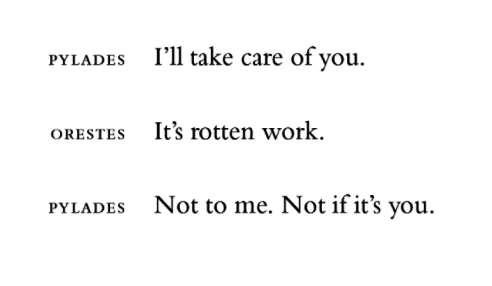
Again…awwwwwwww!
So anyway, in Iphigenia Among the Taurians, Orestes and Pylades show up at the temple, and while they’re making their plans to steal the statue, they’re talking about how much they love and support each other. Not only that, but when they’re captured by the Taurians, Orestes volunteers to sacrifice himself so that Pylades can live.

Anyway, eventually Iphigenia figures out that the captive is, in fact, her brother Orestes, and here’s where the other awesome part of this play comes in. You know how Orestes’ sister Electra helped him when he was trying to figure out how to kill his mother? Well, now his sister Iphigenia helps him figure out not only how to escape, but how to steal that statue he’s there for. And she’s the one who leads the heist, convincing King Thoas that both the captives and the statue need to be cleansed in the ocean before the ritual can take place. They all pull off the thing and escape together.
“But Reina,” I hear you thinking, “that doesn’t sound very tragic at all.” Well, in classical literature there’s a subgenre of tragedy called “escape” tragedy, which generally has a happy ending (the word “tragedy” meant something completely different to the ancient Greeks), and it turns out that Euripides was a big fan of this subgenre.
Come back tomorrow for #6 on my list!
In Proximum, Regina Vestra


 Reina Callier (Artes Reginae Press)
Leave a comment