Greek Tragedy Countdown, #8: The Truth Hurts
In honor of my adaptation of the Greek tragedy Antigone, which releases in 8 days, here’s my eighth favorite Greek tragedy: Sophocles’ Oedipus the King.
So apparently I am a basic bitch, because why else would I put the Greek tragedy that pretty much everyone knows about on this list? How mainstream of me. But sometimes things are mainstream because they’re great, and Oedipus the King a.k.a. Oedipus Rex (originally Oedipus Tyrannos) is truly great.
It’s not just the story, though the story is certainly compelling. Most people know Oedipus’ deal: the king and queen of Thebes ordered a servant to take their newborn son into the wilderness and leave him to die. Why? Because they’d received a prophecy that their son would grow up to kill his father and marry his mother. The servant took pity on the baby and brought him to another city instead, where he was adopted and raised by the king and queen there. He grew up, heard the prophecy that he was going to kill his own father and marry his own mother, and hightailed it out of there, trying to avoid fulfilling the prophecy. Unfortunately, this brought him right back to his actual home city, where he killed a man on the road in a fit of road rage and freed the city from the Sphinx’s reign of terror. The Thebans rewarded him for his heroism by giving him the throne, since the old king had just died in a mysterious road rage incident. As the new king, Oedipus married queen Jocasta…his own mother.
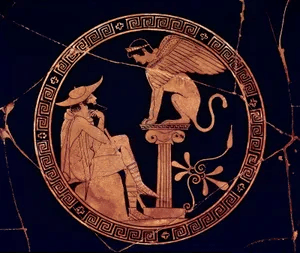
[Oedipus and the Sphinx]
Here’s the weird thing: Oedipus the King, possibly the most famous Greek tragedy, doesn’t cover any of this. Set many years into Oedipus’ kingship (after he and his mother have had four children of their own), the play is not about the infamous events in Oedipus’ life, but the moment that Oedipus discovers who he is and what he has done. When the play begins, a plague is ravaging Thebes, and the oracle at Delphi reveals that the former king’s murderer must be found and punished to remove the famine and pestilence from the city. Being the good king that he is, Oedipus devotes himself to doing whatever it takes to identify and exile the former king’s murderer. As the investigation unfolds, he misunderstands the evidence and ignores the warnings coming at him from all sides, stubbornly pushing forward in his quest for the truth…even though that truth will ruin him.
Here’s what’s so great about this play: the dramatic. fucking. irony.
Keep in mind that the ancient Greek audience already knew this story. The impact of the play is not us finding out the truth about Oedipus, it’s us watching Oedipus find out the truth about Oedipus. It’s like we’re watching the protagonist of a horror movie walk down a dark hallway, blissfully unaware of the monster hiding in the shadows at the end, and we’re screaming and shouting “Don’t go down there!” or “Turn on the fucking lights!” or “Run!” And it’s even more complex than that, because on the one hand, we don’t want Oedipus to find out because it’ll ruin him and he seems like a pretty good guy, but on the other hand…EW OH MY GOD YOU CAN’T KEEP LIVING LIKE THIS.
Sophocles really milks the hell out of all of this. The slow, nauseating drip of information Oedipus receives throughout the play – and the way he manages to misinterpret all of it until it’s just not possible to misinterpret it any more – is sooooo excruciating. And there’s a lot of dark humor in it, as well. When Oedipus swears that he will avenge the old king “as though he were my own father,” we can’t help but laugh. Or maybe cry. Or maybe laughcry. At one point, Jocasta (before she figures everything out and kills herself offstage) tries to comfort Oedipus by telling him, “You know, you shouldn’t put too much stock in oracles, because years ago I received a prophecy that my child would kill my husband and marry me, and obviously that didn’t happen, so oracles are pretty much bullshit.” And BE SO FOR REAL RIGHT NOW, Sophocles, because how were you such a genius???
I’m not even going to touch on the incredible themes in this play: the dangers of knowledge, the inescapability of fate, the fragility of happiness…There’s a reason why this play is so famous. Even the philosopher Aristotle thought it was the best of the best!
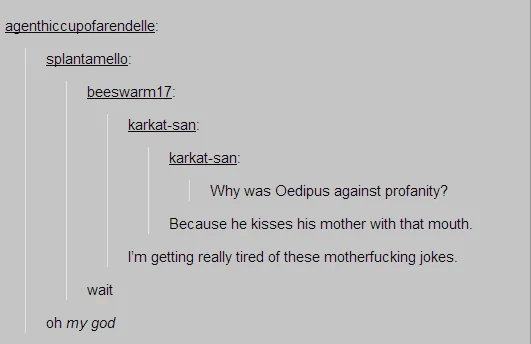
It’s also, just…really great for memes.
Come back tomorrow for tragedy #7!
And, of course, subscribe if you want to be updated when I post.
In Proximum, Regina Vestra


 Reina Callier (Artes Reginae Press)
Leave a comment