Greek Tragedy Countdown, #9: Euripides Lampoons Aeschylus’ Version of Orestes’ Story
In honor of my adaptation of the Greek tragedy Antigone, which releases in 9 days, here’s #9 on my list of my top ten favorite Greek tragedies: Euripides’ Electra.
Yesterday’s pick (#10) was Aeschylus’ Libation Bearers. If you need a refresher on that one, here’s the link:
Aeschylus was by no means the only tragedian to take on the story of Orestes’ terrible predicament, i.e., the fact that he was ordered by the god Apollo to kill his own mother (Clytemnestra) after she killed his father (Agamemnon). Both Sophocles and Euripides wrote their own versions. Theirs were both titled Electra, and while they both followed Libation Bearers in exploring Orestes’ return to his homeland, reunion with his sister Electra, and revenge against his mother, they also gave a larger role to Orestes’ sister (as one might guess, given that she’s the titular character).
But it’s Euripides’ version of Electra that I want to talk about today, for while Sophocles’ version is undeniably wonderful, Euripides’ version seems to have a lot of fun subverting Aeschylus’ precedent.
Remember how I talked about the ridiculous recognition scene in Libation Bearers? Where the proof that Orestes is Electra’s sister is 1) that the locks of their hair match and 2) that their footprints are the same? Euripides, writing decades later, lampoons this scene explicitly:
Old Man: …Look at this hair, compare it to your own:
see if your color matches with the lock…
Electra: Gosh, what a silly thing to say, old man!…
…how can you expect the locks to match?
…people who aren’t related
often have matching hair color. You know that.
Old Man: Then step into the marks his boots have made,
see if your foot will match its size, my child.
Electra: But how could there be any print at all
on stony ground? Or even if there were,
the man and woman’s feet won’t match together
even for siblings!
[translation by Emily Wilson, from The Greek Plays, eds. Lefkowitz and Romm. Modern Library, 2016.]
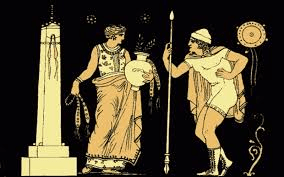
Eventually, of course, Orestes does have to prove his identity. Euripides has him do this by means of a scar (a classic trope that we see in the Odyssey, as well).
Euripides does some other interesting things with the story, too. In typical Euripidean fashion, he questions the idealistic (and often overly-simplistic) portrayal of heroism in earlier works. In Euripides’ version, Orestes comes across as cowardly, and he needs A LOT of help from his sister Electra to complete his task. Electra is so strong that she seems overbearing. Electra and Orestes aren’t just worried about avenging their father; they’re worried about their status and inheritance. And Clytemnestra is not as straightforward a villain. In a lengthy conversation with Electra, she tries to justify her past behavior while also admitting that she regrets how far she let her anger take her. This is something Euripides does very well, exploring shades of gray rather than subscribing to a black-and-white concept of morality. And it’s why his take on the Orestes story is so fascinating.
Side note: it’s stuff like this that makes me roll my eyes whenever people complain about remakes, reboots, and retellings. Aeschylus, Sophocles, and Euripides all felt they had something new to bring to a story that had been told for centuries, and we consider all of their interpretations not only to be worthwhile but also to be classics in their own right!
Come back tomorrow for tragedy #8!
And, of course, subscribe if you want to be updated when I publish new posts.
In Proximum, Regina Vestra


 Reina Callier (Artes Reginae Press)
Leave a comment